We Didn't Set Out to Build a Payment Platform. We Set Out to Build a Flywheel.
November 1, 2026
A school saving on fees and a child learning to save are not two different stories. In our model, they are the same story.
For ten months, I have been writing to two audiences. From February to July, I wrote to bursars and principals — about admin overload, dirty and clean transactions, and the hidden costs of cash on campus. From July to October, I wrote to parents — about banning the word 'wallet', about 4.2%*, about lighthouse parenting.
A few readers have asked me, fairly: so which is it? Are you a school payments company or a kids' money company?
The answer is neither, on its own. We are both, deliberately, because the real value lives where the two meet. This month I want to show you that overlap, because it is the part of Sticitt I am proudest of, and the part I believe sets us apart.
Built around the ecosystem, not the transaction
Most payment providers start with a transaction and look for places to sell it. A bank starts with an account and looks for customers to open it. An admin platform starts with a school's back office and stops at the school gate.
We started somewhere else. We started with the education ecosystem itself: the school, the parent, the child, and the tuckshops, uniform shops, ticketing, printing and vending partners that live around them, and asked one question: how should money flow through this community so that everyone in it ends up stronger?
Everything we have built since answers that question from one of two sides.
World one: the most cost-effective payment infrastructure for schools
Saves costs: Fewer providers, lower processing costs, no cash handling.
Increases revenue: When it is easier to pay with more payment options, more people pay, and they pay sooner: fees, fundraisers, events, the tuckshop.
Reduces admin time: Every payment point and payment option reconciles in one place and plugs into the tools the school already uses.
Builds safer, cash-free campuses: No coin tins, no cash runs to the bank, nothing worth targeting at the gate.
That is the school half. On its own, it is a good business.
World two: the Sticitt Account for parents and kids
For families, the Sticitt Account gives parents the tools to raise financially confident kids. It is built around our 6 healthy money habits:
Earn Money: link money to tasks that add value at home or in the community.
Budget Money: work out together what they should spend; teach them to plan.
Save Money: set a goal and reward reaching it; teach them to save.
Value Money: review and reflect on past spending; teach them to value money and fight instant gratification. Don’t build little consumers, build contributors!
Invest Money: put money to work for the future, with patience; teach them delayed gratification.
Share Money: give, and build empathy and generosity. Teach them they are part of a community; it is not just about them.
What makes these habits stick is putting them into practice through the everyday money experiences children encounter. The R12 at first break. The civvies day contribution. The sports tour deposit. The birthday money that goes toward a goal. The lesson is attached to the moment the money actually moves, not to a worksheet on a Sunday afternoon.
That is the family half. On its own, it is also a good business worth building.
Where the two worlds overlap
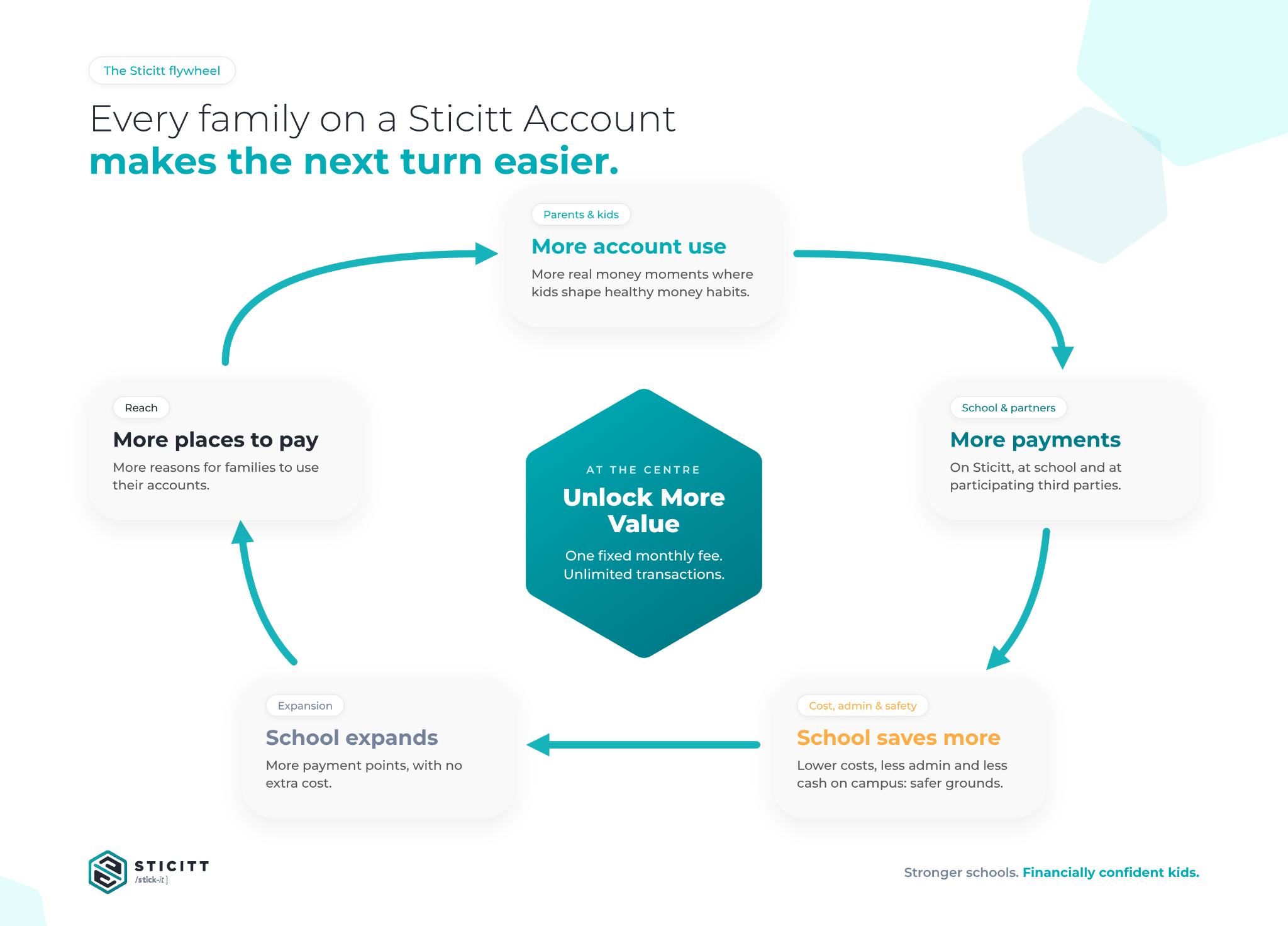
Here is the part that matters. These two halves are not just sold side by side. They power each other, and our Unlock More Value pricing is what joins them.
Under Unlock More Value, a school pays one fixed monthly fee for unlimited transactions on our infrastructure whenever parents and kids pay from their Sticitt Accounts. Now follow what happens next:
More parents and kids use their Sticitt Accounts, and every payment is a real money moment where kids shape healthy money habits.
More payments flow through those accounts, at the school and at participating third parties.
The school saves more on cost and admin time, because every one of those payments sits inside a fixed fee. Less cash on campus also means safer grounds.
The school expands its Sticitt infrastructure; another payment point, another event, another partner, because each one now adds value without adding cost.
Parents and kids get more places to use their accounts, which brings us back to the start.
One turn feeds the next. That is a flywheel. Schools can save up to 80% on payment processing fees by onboarding parents to Sticitt Accounts vs our normal direct payment options, and every family that joins makes the next turn easier.
Why the incentives finally line up
Putting my CFA hat on for a moment. In a traditional per-transaction model, a school's payment cost grows with its success. More events, more fundraisers, more tuckshop volume — a bigger bill. The provider's revenue is the school's cost, and the two quietly pull in opposite directions.
A fixed fee flips that. The cost of the school's next payment on a Sticitt Account is zero, so the rational move is to bring every payment onto the rail. Our own growth comes from families choosing the Sticitt Account and continuing to use it, which only happens if it is genuinely useful to them. And a family using the account every day is a family building habits every day.
The school's savings, the family's habits and our growth all point in the same direction. As I wrote in August, alignment is the number that matters. This is alignment designed into the whole model, not just one rate.
What sets us apart
Our flywheel, which focuses on building stronger communities and helping future generations prosper, sets us apart.
Each part of it competes with the best out there: our payment infrastructure, built for the education and school market, and our youth account offering. Others simply forgot to build a flywheel in the first place.
We did not set out to build a better payment product or a better kids' account. We set out to build a flywheel, one that creates stronger school communities and a more exciting future for our kids.
So I'll leave you with a question: does anything similar exist in the South African, or global, market?
The honest part
A flywheel only spins if someone pushes it. In September, I shared that only 74 of 9,674 kids on our platform had a lesson attached to their money. That number is the flywheel's friction, and reducing it is our job, not our parents'. Making the Sticitt Account the easy default for every school payment is how we keep the wheel turning. Continuing my #BuildinPublic, that number stood at 3,873 starting in October; we’re now at 4,555. Not the growth we had in October, but definitely moving in the right direction🚀
What this means for you
If you lead a school: Ask us to model Unlock More Value for your school. The more of your parents who pay from Sticitt Accounts, the more you keep, and the more you can safely bring onto the platform.
If you are a parent: Open your child's Sticitt Account, attach one of the 6 habits to the next payment you make, and watch what the conversation becomes.
Every turn of the wheel builds something bigger than a payment. It builds a stronger school, and a child who will grow up confident with money. Next month, I want to step back and share why that matters so much to us… Why Sticitt exists at all.
When in doubt, paddle out. Theo Kitshoff Co-founder & CEO, Sticitt